Buying a backlink is easy. Choosing a placement that fits your audience, survives editorial scrutiny, and makes sense within a long-term SEO strategy is much harder. A high Domain Rating (DR) can look reassuring while the actual article has no readers, the site's topical focus is unclear, or the publisher sells links indiscriminately.
This checklist is designed for site owners and marketers assessing editorial link opportunities in the United States, Canada, Australia, Europe and Ukraine. It helps you compare candidates consistently without treating any third-party metric as a guarantee of Google rankings.
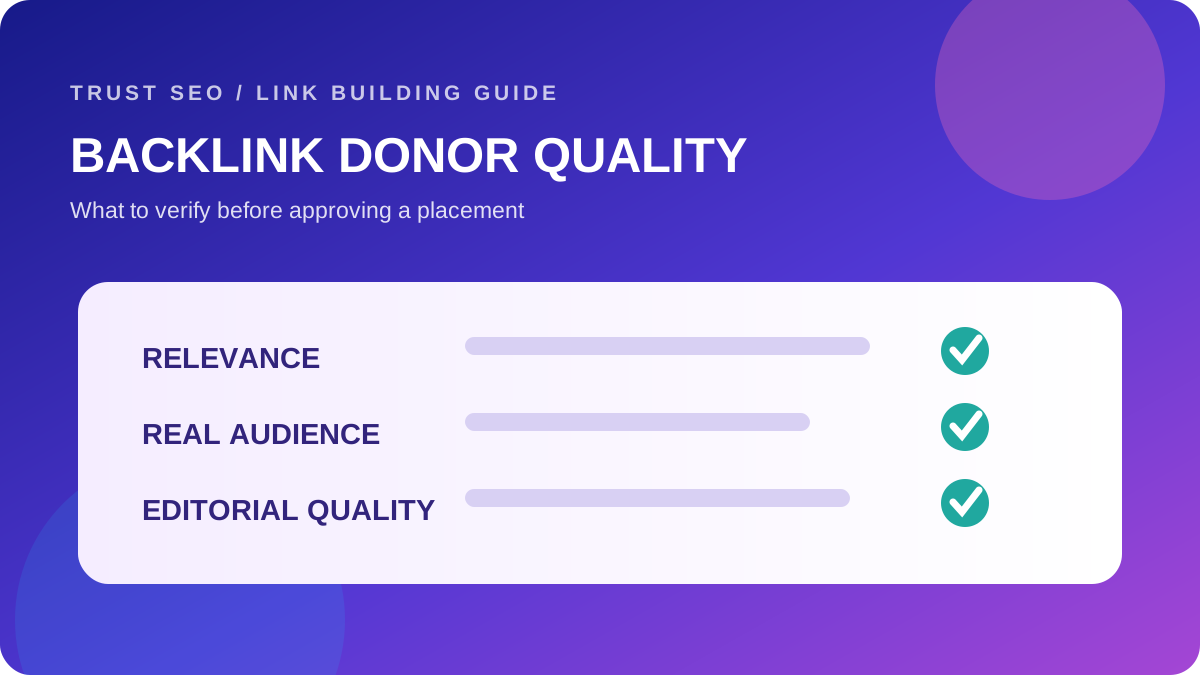
Start with the page, not the domain score
Ask where the link will appear and why a reader would follow it. A relevant article on a modest specialist publication can be a more sensible choice than an unrelated post on a high-metric general website. Look at the proposed page, its category, the site's audience, and the surrounding editorial material.
For a Canadian SaaS company, for example, an English-language article about workflow software on a Canadian business publication may be more relevant than a generic international lifestyle blog. Geographic fit is a contextual signal, not a rule that every backlink must come from the target country.
The 10-point backlink donor checklist
| Check | What to examine | Potential warning sign |
|---|---|---|
| 1. Topical fit | Category, adjacent articles and reader intent | Unrelated sponsored content across many niches |
| 2. Audience | Language, geography and realistic reader profile | Traffic from markets irrelevant to the campaign |
| 3. Organic visibility | Ranking pages and trend over time | Sudden collapse without a clear explanation |
| 4. Page quality | Original research, useful examples, clear authorship | Thin or duplicated articles |
| 5. Link profile | Referring domains, anchors, growth patterns | Obvious manipulation or repetitive exact-match anchors |
| 6. Outbound links | Where the publication links and how often | Repeated links to unrelated commercial sites |
| 7. Placement | Natural in-text context and target-page fit | Hidden, boilerplate or irrelevant insertion |
| 8. Editorial policy | Disclosure, review process and correction policy | No editorial standards or unclear sponsorship terms |
| 9. Commercial terms | One-time fee, maintenance and removal conditions | Promises of permanent placement without written terms |
| 10. Evidence | Published URL, link attributes and reporting | Only a screenshot, with no verifiable URL |
Use this as a decision aid rather than a rigid scoring algorithm. A serious problem with editorial integrity can outweigh several positive metrics.
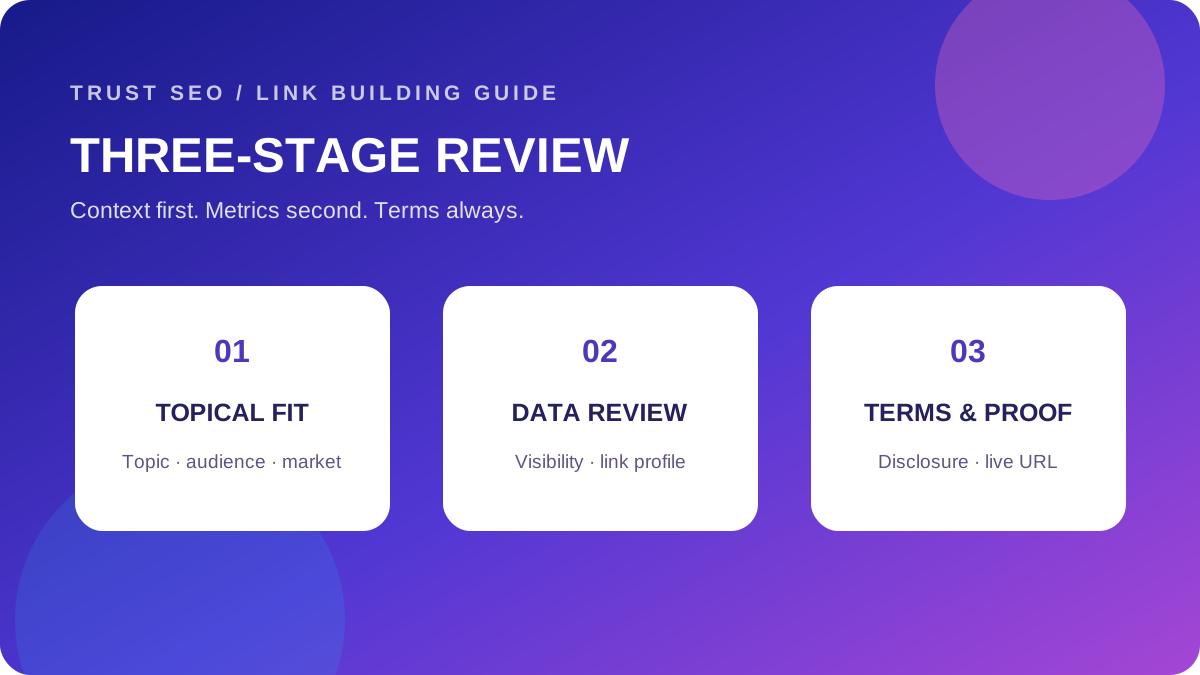
How to interpret DR, Trust Flow and Citation Flow
Ahrefs Domain Rating describes the relative strength of a domain's backlink profile; it does not measure editorial quality or guarantee search traffic. Majestic's Trust Flow and Citation Flow provide different views of the link graph. These figures can help flag unusual patterns, but they are estimates produced by independent tools, not Google ranking scores.
Compare domain-level and URL-level data. Inspect which pages actually receive organic visits and whether the proposed placement is likely to be discoverable. A high domain score does not automatically transfer meaningful value to a newly created, isolated page.
For a deeper discussion, read our Trust Flow vs Citation Flow guide.
Check organic traffic for relevance, not just volume
Traffic estimates can be inaccurate. Instead of looking only at a monthly total, review the site's main ranking topics, country distribution and trend. A publication whose visitors mostly search for unrelated topics may offer little meaningful exposure for your business.
Also look for signs of genuine readership: coherent editorial categories, articles that answer real questions, updated resources and natural navigation. A legitimate niche publication may have limited measurable traffic and still serve a valuable audience.
Evaluate the landing page as well as the donor
Even a credible publication is a poor match when the destination page does not satisfy the reader's intent. Before approving an opportunity, inspect the target page for clear answers, accurate information, fast loading and a natural connection to the publisher's topic. For commercial pages, check that the page describes what the business actually offers rather than relying on exaggerated promises.
Build a small mix of relevant landing pages instead of pointing every placement at the homepage. Educational articles can be appropriate destinations when they genuinely explain a subject; service pages may fit when readers are actively comparing providers. Anchor text should reflect the sentence and not repeat an identical commercial keyword across unrelated publications.
Review the exact placement and link attributes
Request the intended article topic and placement format before ordering. The link should help the reader understand or verify something relevant, rather than interrupting the article. Agree on the target URL and anchor wording in advance, but allow editorial judgment when a more natural phrasing improves the page.
Google distinguishes links with attributes such as rel="sponsored", rel="nofollow" and rel="ugc". Paid placements intended to influence rankings can violate Google's spam policies. Ask how the publisher labels sponsored material and do not assume a paid dofollow link is risk-free.
Permanent placement does not mean a lifetime guarantee
In link-building offers, “permanent” usually describes a one-time placement fee rather than monthly rental. Websites can change ownership, remove content, go offline or update their editorial policies. Before paying, clarify the expected retention period, replacement policy, link attributes and what happens if the article disappears.
Keep a record of the agreed terms and check the live URL after publication. Treat any promise of guaranteed rankings, indexing or indefinite retention with caution.
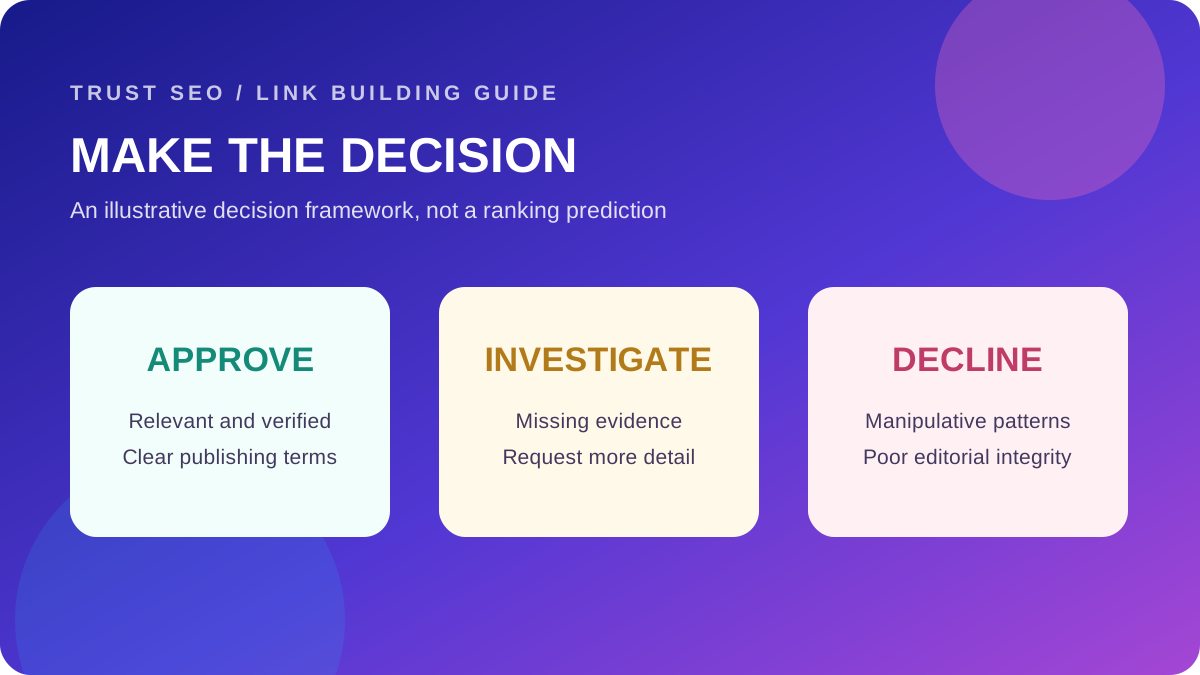
A practical review workflow
- Define the target. Choose the destination page, audience, language and campaign objective.
- Shortlist relevant publications. Start with editorial fit, not a minimum DR threshold.
- Inspect candidates manually. Review recent articles, outbound links and audience relevance.
- Compare independent data. Use several metrics to identify anomalies, not to replace judgment.
- Confirm publication terms. Agree on format, disclosure, link attributes, fee and reporting.
- Verify delivery. Open the published URL, inspect the context and record the result.
- Monitor over time. Recheck availability and assess referral activity and broader organic trends without attributing every ranking change to one link.
Example: comparing three hypothetical opportunities
| Candidate | Strength | Concern | Next step |
|---|---|---|---|
| A: specialist industry blog | Excellent topic fit; engaged niche audience | Moderate domain metrics | Inspect placement and editorial terms |
| B: large general publication | Recognizable brand; broad reach | Proposed article is off-topic | Request a relevant section or decline |
| C: high-DR guest-post network | Attractive headline metrics | Repetitive commercial links and thin articles | Reject until concerns are resolved |
These examples are illustrative, not actual donor assessments or performance claims.
How to compare costs without chasing the cheapest link
Price comparisons should include more than the initial placement fee. Record the editorial work required, whether the article is written by the publisher or supplied by the advertiser, any revision costs, the publication's retention terms and the effort needed to verify the result. A low-cost placement that must be replaced repeatedly can consume more time than a well-matched editorial opportunity.
Do not convert DR bands into an assumed SEO return on investment. Ranking movement depends on many factors, including site quality, content, competition and search-system changes. Where possible, track referral visits and relevant enquiries alongside longer-term organic performance, and keep these outcomes separate in your reporting.
What to request in a placement report
A useful report identifies the publisher, live page URL, target URL, anchor, observed link attributes, publication date and any agreed follow-up period. Where relevant, it should distinguish the original agreement from what was actually published. Screenshots can support a report but should not replace a working URL.
For discussion-based placements, the editorial context differs. See our crowd link-building service to understand that separate format.
Choose a link-building approach that fits your site
No checklist can eliminate uncertainty. Sustainable decisions start with useful destination pages, credible publishing environments, clear commercial terms and honest measurement. If you want help evaluating opportunities for a specific market, explore our permanent backlink packages or discuss your project on Telegram. We can review the topic, language and target geography before recommending a placement format.
View permanent backlink packagesDiscuss on Telegram