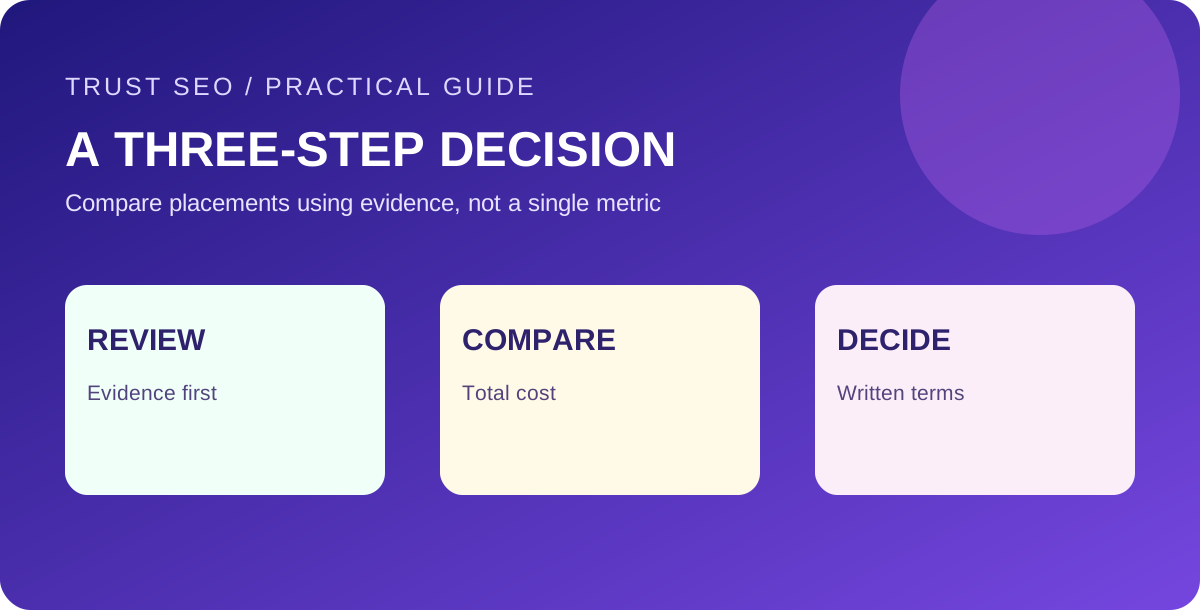
Permanent and rented backlinks can look similar on a live page, yet their payment models, removal conditions and long-term costs differ. The important question is not which label sounds better, but whether a placement is relevant, editorially appropriate and supported by clear terms.
This guide compares the two models for teams targeting the United States, Canada, Australia, Europe and Ukraine. It focuses on practical due diligence, realistic budgeting and what to verify after publication—not promises of search rankings.
What is a permanent backlink?
A permanent backlink is typically sold as a one-time placement, without a recurring rental fee. In practice, “permanent” describes the commercial arrangement, not a guarantee that a publisher will operate forever or retain a specific URL indefinitely. A page can be edited, redirected, removed or deindexed, and agreements vary by publisher.
Ask whether the link appears in an existing article or a newly published piece, whether it is editorially reviewed, and what happens if the page disappears. Check the actual URL, surrounding copy, link attributes and any disclosure requirements.
What is a rented backlink?
A rented backlink normally involves a recurring charge for maintaining the placement. If payment stops, the publisher or intermediary may remove the link. A low initial price can therefore become more expensive over time. Rental is not inherently a measure of quality: the publishing context and compliance with search-engine policies still matter.
Permanent vs rented backlinks: practical comparison
| Question | One-time / permanent model | Recurring / rental model |
|---|---|---|
| Payment | Usually a single agreed placement fee | Monthly, quarterly or annual payments |
| Retention | No routine rental bill, but retention is not guaranteed | Often dependent on continued payment |
| Budgeting | Higher initial spend may be easier to cap | Lower entry cost may compound over time |
| Removal risk | Publisher changes, site closure, policy or contract terms | All normal publisher risks plus non-renewal |
| What to verify | Placement, URL, link attributes, editorial and removal terms | All of the above plus renewal, price changes and cancellation |
| SEO impact | Neither payment model guarantees indexing, traffic, rankings or a positive outcome | |
rel="sponsored". Evaluate editorial value and disclosure rather than treating any purchased link as a guaranteed ranking signal.Cost example: why the time horizon matters
Consider two illustrative offers for comparable placements: a one-time fee of $180 and a rental fee of $15 per month. These are examples for understanding cost structure, not TRUST SEO quotations or market averages.
| Period | One-time placement | Rental at $15/month | Difference |
|---|---|---|---|
| 6 months | $180 | $90 | Rental costs $90 less |
| 12 months | $180 | $180 | Equal cumulative spend |
| 24 months | $180 | $360 | Rental costs $180 more |
| 36 months | $180 | $540 | Rental costs $360 more |
The break-even point in this example is 12 months ($180 ÷ $15). This calculation says nothing about editorial quality, organic visibility or whether either placement will remain live. Compare like-for-like pages and contractual conditions before making a decision.
How to evaluate the donor—not just the price
1. Topical relevance and real audience
Inspect the proposed article, surrounding category and publication’s regular readership. A specialist page that answers a genuine audience need may be more useful than a generic high-metric site. Geographic relevance matters when it reflects the audience: a Canadian software company may value a relevant Canadian industry publication, but a donor does not have to be hosted in Canada to reach Canadian readers.
2. Organic visibility and site quality
Review ranking pages, traffic trends and content depth. Third-party DR, Trust Flow and Citation Flow are useful diagnostic estimates, not Google ranking scores. Investigate sudden traffic declines, copied content, unnatural outbound-link patterns and pages created solely to sell placements.
3. Placement and commercial conditions
Confirm the final destination URL, anchor wording, surrounding paragraph, link attributes, disclosure, review procedure, publication timeline, cancellation rules and what evidence you will receive. If the offer uses the word “lifetime”, ask whose lifetime and what remedy—if any—applies when the page is removed.
For a detailed donor assessment, use our 10-point backlink donor checklist and the Trust Flow vs Citation Flow guide.
Which model fits different situations?
| Situation | Practical approach | Reason |
|---|---|---|
| Long-term resource or evergreen guide | Consider a clearly documented one-time editorial placement | More predictable spending over a long planning horizon |
| Short, time-limited campaign | Compare limited-duration options with transparent end dates | Recurring spend may match a temporary need, but cancellation terms matter |
| New site with a small budget | Prioritize content quality and selective, relevant outreach | Buying many low-quality links is not a substitute for useful content |
| International B2B project | Match the publication to language, topic and audience | Audience fit matters more than a donor’s country label alone |
What to verify after publication
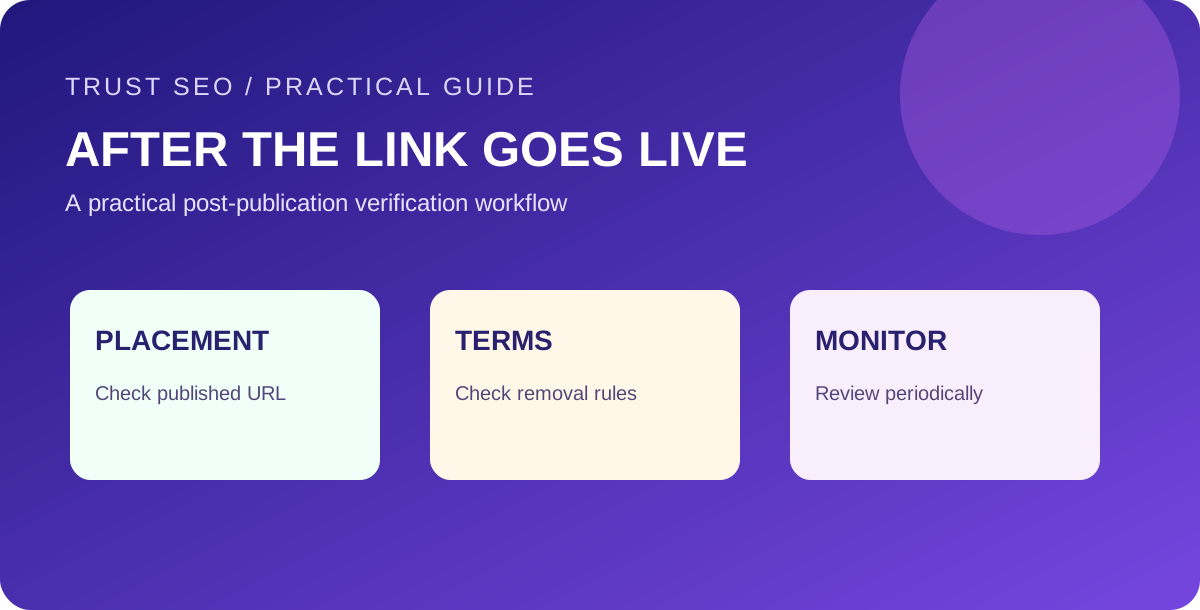
- Open the live URL. Confirm the page loads and the surrounding content matches the approved placement.
- Inspect the link. Check destination, anchor, HTML attributes and any required sponsorship disclosure.
- Record the evidence. Save the published URL, date and agreed commercial terms; a screenshot alone is not sufficient.
- Monitor changes. Recheck the page periodically for removal, redirects, noindex directives or changed link attributes.
- Review outcomes cautiously. Evaluate referral visits and wider campaign performance without attributing every ranking change to one link.
Frequently asked questions
Does permanent mean a backlink will never disappear?
No. It usually means a one-time payment arrangement rather than a subscription. The publisher may still change or remove content, and no website has guaranteed indefinite availability.
Are rented backlinks always cheaper?
Not over every time horizon. Compare cumulative fees, cancellation terms and equivalent publishing quality. A rental can cost less initially and more after multiple renewals.
Will either model guarantee better rankings?
No. Search engines evaluate many signals, and paid links intended to manipulate rankings can trigger spam-policy concerns. Focus on relevant editorial value, transparency and appropriate link attributes.
What should a placement report contain?
At minimum, the live URL, publication date, target URL, anchor, link attributes and the agreed placement terms. Follow-up checks are useful when retention matters.
Next step: choose placements deliberately
Before committing a budget, compare actual donor pages and written conditions. For our available formats and project-specific discussion, explore permanent backlink placements. For community participation as a separate approach, see crowd links. The two services have different contexts and should not be treated as interchangeable.