TRUST SEO Editorial · 5 November 2026 · International link-building guide
Choosing a website for a permanent backlink requires more than an authority score. This guide gives you a repeatable way to assess audience fit, editorial standards, technical placement and retention terms before you commit a budget.
Designed for campaigns targeting the United States, Canada, Australia, Europe and Ukraine, this checklist focuses on evidence and realistic terms—not guaranteed search rankings.
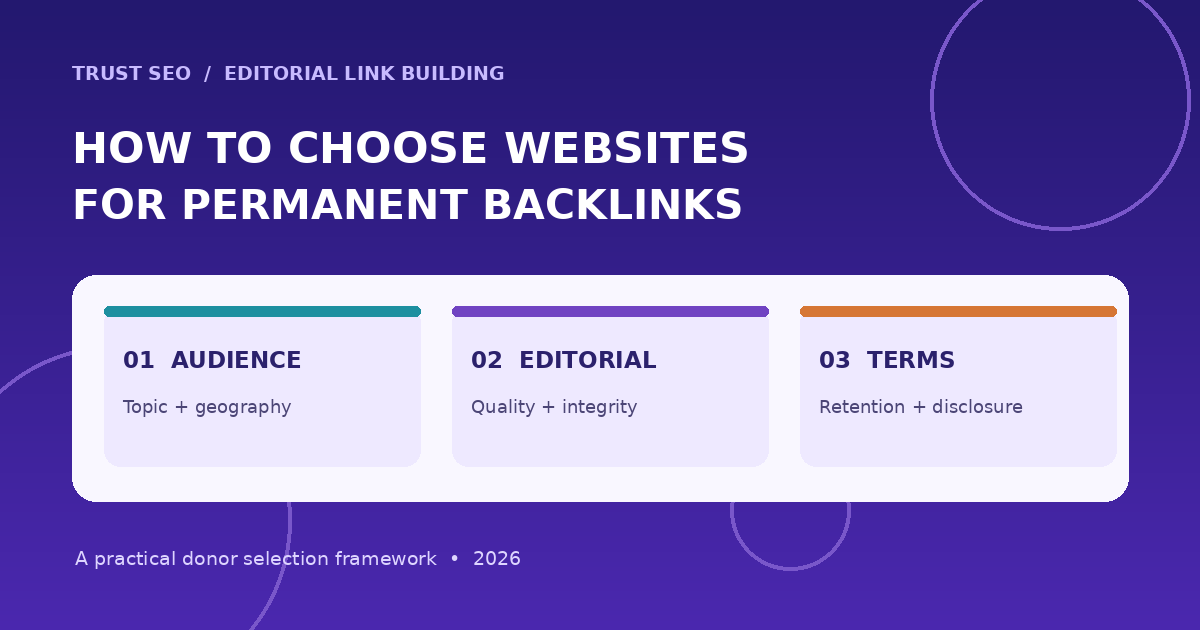
Start with the audience, not a domain score
A permanent backlink is only as useful as the page and editorial context around it. Before opening a metrics tool, write down who should plausibly read the placement and what question the linked destination answers. A cybersecurity SaaS company, for example, may find a modest but active security publication more relevant than a high-scoring general directory. A regional manufacturer may need trade publications that serve buyers in its actual markets rather than sites with impressive global traffic but no purchasing audience.
Use a short relevance brief: target market, language, reader role, topic, intended destination and the editorial angle that makes the link helpful. If you cannot explain why a reader would follow the link, reconsider the opportunity. Relevance is not a substitute for quality checks; it is the filter that makes subsequent checks worthwhile.
Check the publication as a reader would
Open the home page, category archive, author pages and several recent articles. Look for original reporting, named contributors where appropriate, clear corrections or contact information, and evidence that topics follow a coherent editorial scope. Inspect whether commercial content is identified honestly. A site can have genuine advertising and still serve its audience; the warning sign is a publication that appears to exist mainly to sell outbound links.
Read the exact proposed placement page if it already exists. Ask whether the surrounding paragraphs support the destination and whether the anchor describes the linked resource naturally. A contextual link inserted into an unrelated paragraph is weaker editorially than a citation that helps the reader verify a claim or learn more.
Read traffic and visibility signals carefully
Estimated organic traffic, ranking keywords and authority scores are third-party indicators, not facts about how Google values a link. Review directional trends rather than one screenshot. Check whether the publication ranks for topics connected to its audience, whether traffic appears concentrated in one unrelated page, and whether large swings have plausible explanations. Compare multiple dates where possible.
For an international campaign, inspect geography and language fit. A Canadian B2B project may need Canadian or North American readers, while an Australian consumer campaign may benefit from a locally relevant audience. The donor’s country-code domain is not proof of its actual readership. Likewise, a European publication may be useful to several markets when its language, subject and distribution align with the campaign.
Audit outbound links and editorial patterns
Sample recent posts from different sections. Do the external citations point to credible, topically connected resources? Are anchors diverse and descriptive, or do you see repeated exact-match commercial phrases? Are there obvious clusters of unrelated industries on adjacent pages? Inspect both the linking page and the wider publication; a respectable-looking single article can sit inside a low-quality network.
Check whether the publisher permits a relevant editorial contribution or merely promises placement without review. Be cautious of guaranteed ranking claims, secret networks, mass placement packages and any arrangement requiring deceptive link attributes. Google’s spam policies treat links intended to manipulate rankings as link spam, and paid placements should use appropriate attributes such as rel="sponsored" or rel="nofollow" where applicable.
Verify the proposed page, not just the domain
A site-wide metric does not tell you whether the particular article will be discoverable or maintained. Confirm the proposed URL structure, whether the page will be reachable through category or related-content navigation, and whether the content will be publicly accessible without login. Review its canonical tag, robots directives and likely internal links after publication. A new page may not be indexed immediately, and no publisher can guarantee indexation.
Ask whether the publisher may later move the article, rewrite the anchor, change link attributes or remove the page. Record the answer in writing. When an article is updated, an editorially justified change can be reasonable, but the client should know which changes require notification.
Understand what “permanent” actually means
Permanent is usually a commercial description of the payment model or intended retention period, not a technical guarantee that a URL will exist forever. Publishers can close, redesign, merge content, change ownership or enforce new editorial policies. A one-time payment may avoid recurring rental fees while still leaving removal risk.
Clarify the agreed retention term, whether it begins at publication, which events allow removal, whether a replacement placement is offered, and what happens if the website becomes inaccessible. Ask whether the link can be marked sponsored or nofollow according to editorial and search policy. Do not treat an agreement to keep a link live as a promise of rankings, referral traffic or Google indexation.
Compare offers using a decision matrix
Use a weighted assessment rather than selecting the cheapest site or highest authority score. The example below is an editorial planning aid, not a Google ranking formula. Score each criterion from 0 (poor or unknown) to 3 (strong and verified). Require an acceptable minimum for relevance and editorial integrity before considering price.
For example, Publication A scores well for audience fit and editorial standards but costs more. Publication B has a higher authority estimate but weak topical fit and aggressive commercial anchors. Publication A may be the better candidate even when its metric dashboard looks less impressive. Unknowns should trigger a question, not automatically receive a passing score.
| Criterion | What to verify | Weight |
|---|---|---|
| Audience relevance | Reader role, language, geography and topic | High — required |
| Editorial integrity | Original content, coherent scope, disclosure | High — required |
| Placement quality | Context, navigability, anchor and attributes | High |
| Visibility signals | Relevant search presence and trend stability | Medium |
| Retention terms | Duration, removal and replacement policy | High |
| Total cost | Upfront fee, renewal costs, verification effort | Medium |
Decision rule: reject a candidate that fails relevance or editorial integrity, even if it scores well on price or a third-party metric.
A practical due-diligence workflow
First, collect candidate publications from industry research, legitimate outreach and competitor citations. Second, shortlist sites by audience and topic. Third, manually review editorial quality and outbound link patterns. Fourth, inspect the proposed page and its technical accessibility. Fifth, document price, attributes, retention conditions and disclosure requirements. Sixth, approve the placement only after the editorial rationale is clear.
After publication, open the final URL, check the rendered link and destination, record the anchor and attributes, and save the verification date. Recheck periodically. The goal is a traceable placement record, not an unsupported claim that one backlink caused a ranking increase.
Common red flags that should stop a purchase
Decline or investigate further when a seller guarantees top rankings, refuses to identify the actual publication before payment, offers unrelated niches in bulk, cannot explain removal terms, or promises to hide paid-link disclosures. Treat repeated unnatural anchors, thin AI-generated filler and pages inaccessible from normal site navigation as reasons for closer scrutiny.
A low price is not itself evidence of poor quality, and a high price is not evidence of editorial value. The decisive question is whether the publication, page and agreement withstand independent review.
FAQ: what buyers ask before ordering
Is a permanent backlink guaranteed forever? No. The term generally refers to an intended lasting placement or one-time payment, subject to the publisher’s documented conditions.
Should I choose the highest-DR site? Not automatically. Third-party scores are useful screening signals but cannot replace relevance, editorial review and placement-level checks.
Can a paid link pass ranking signals? Search engines set their own policies. Google advises qualifying paid links with rel="sponsored" or rel="nofollow"; buying links to manipulate rankings carries policy risk.
How quickly should I judge results? Verify delivery immediately, then examine traffic and search performance over several comparable periods. Do not attribute a change to one link without stronger evidence.
Editorial note: examples are illustrative. Follow applicable advertising disclosures and search engine policies. No placement guarantees rankings, indexation or future availability.